
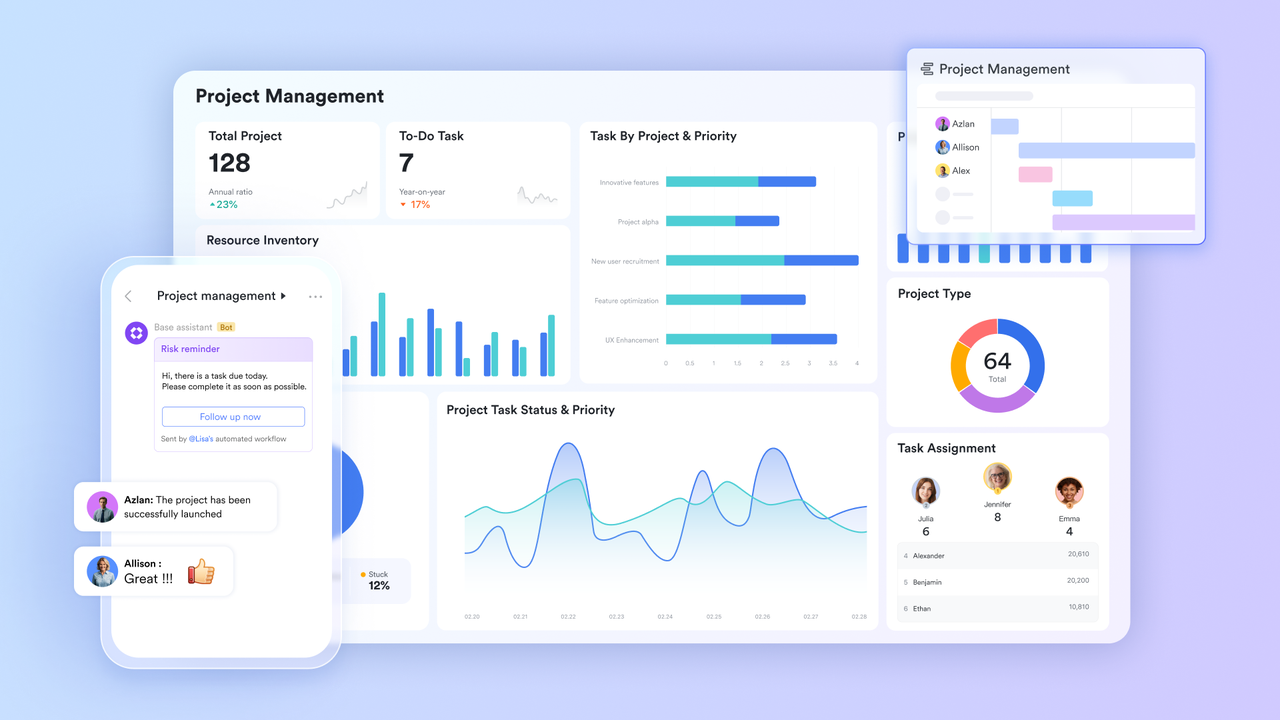
Creative teams are remarkably good at producing work. They are often far worse at managing what happens to it afterward. The copy is written and shared for review. Feedback arrives from five different people through five different channels: a comment in a Google Doc, a voice note in a WhatsApp thread, an email from the client, a Slack message from the creative director, and a set of tracked changes in a Word file attached to a reply to a reply. The writer who now has to reconcile these five streams of feedback into a single coherent revision is not doing creative work. They are doing editorial archaeology, and they will spend more time on that excavation than they spent writing the original piece. This is the revision loop, and it is not a discipline problem or a communication style problem. It is an infrastructure problem. When feedback has no home, no structure, and no resolution mechanism, it circles endlessly rather than landing. The creative teams that have escaped this loop have done it with project management tools that give feedback a single location, a clear owner, and a visible status from the moment it is left.
Feedback that lives where the work lives with Lark Docs
The root cause of the revision loop is spatial: the feedback is separated from the work it refers to. When a reviewer writes a general email saying “the second section needs to be stronger,” the writer has to interpret what “stronger” means, locate the second section, determine which specific element was being criticized, and make a judgment call about how to respond without any additional context. That judgment call may be wrong, triggering another round of feedback that repeats the same separation problem. The revision loop is a direct consequence of feedback that does not arrive attached to the specific element it concerns.
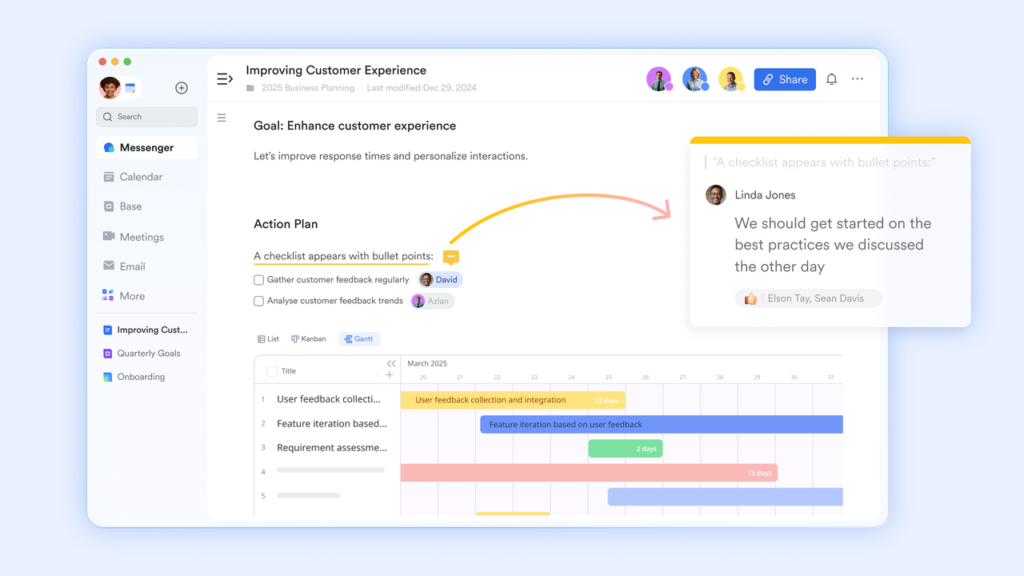
Lark Docs eliminates the spatial separation by making feedback a property of the document itself rather than a message about it. “Comment” threads allow reviewers to attach feedback to the precise sentence, paragraph, or section they are addressing, so the writer receives full context alongside the note rather than having to reconstruct it. Each comment thread remains open and visible until it is explicitly resolved, so outstanding feedback is never invisible and no revision round can be considered complete while unresolved comments remain. “Version History” means the writer can trace the evolution of any section across revision rounds, so when a later reviewer undoes a change that an earlier reviewer requested, the conflict is visible and resolvable rather than creating silent divergence between the review and the document.
Presentation reviews that close rather than circle with Lark Slides
The revision loop is especially costly in presentation work because presentations are visual, client-facing, and frequently revised under time pressure. A campaign deck reviewed by four stakeholders typically generates feedback in four different formats: a marked-up PDF, an annotated screenshot, a voice message describing a slide by its approximate position in the deck, and a list of bullet points in an email that could apply to any of six slides. The designer who has to reconcile this feedback before the next client meeting is not designing. They are decoding.

Lark Slides allows every reviewer to leave comments directly on the specific slide, text block, or visual element they are addressing, so the feedback is spatially anchored to the work from the moment it is written. Real-time co-editing means that when multiple reviewers are working on a deck simultaneously, each person sees the others’ contributions as they arrive, eliminating the version divergence that makes multi-stakeholder presentation reviews so difficult to resolve. The “live link” feature allows the final deck to be shared with external stakeholders via a permanent link that always shows the most current version, so the client is never looking at an outdated file and the team is never managing parallel versions across different email threads.
A single tracker for every creative asset in flight with Lark Base
Creative teams managing multiple projects simultaneously need a live view of which assets are in which state across the full pipeline. When that view exists only in a project manager’s head, or in a spreadsheet that was last updated on Tuesday, or in a status message posted to a channel that nobody checks reliably, the team operates with a blurry picture of its own workload. Brief written, copy in progress, design pending review, legal clearance outstanding, client approval received: each of these states needs to be visible to everyone on the team without anyone having to ask the project manager to reconstruct the picture on demand.
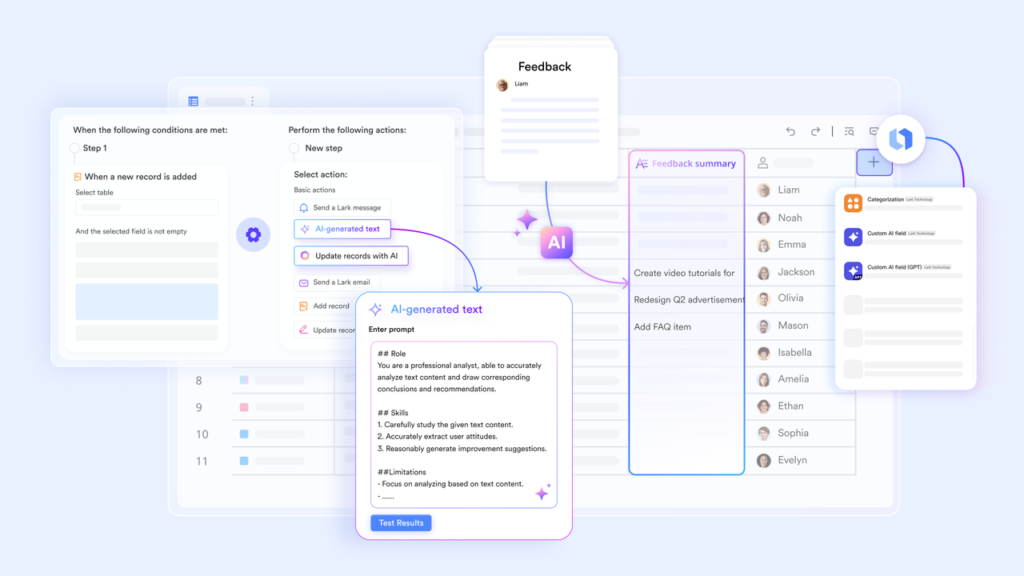
Lark Base gives the creative team a live operational database where every asset has a named owner, a clearly defined status, and a linked history of the feedback it has received. Gallery view displays visual assets as a grid that creative directors can scan at a glance, so reviewing the current state of a campaign’s visual identity takes seconds rather than requiring someone to open each file individually. Automated notifications trigger when an asset’s status changes, so the copywriter knows the moment a brief has been approved and is ready for them, and the designer knows the moment the copy has been signed off and they can begin layout. The team’s operational picture updates itself continuously rather than requiring a daily standup to maintain.
Approval that does not restart the revision clock with Lark Approval
One of the most frustrating dimensions of the revision loop is when a piece of work reaches the final approval stage only to be sent back with new feedback that was not raised in any prior review round. This happens partly because approval processes lack structure: the approver is not given a clear brief about what they are approving against, the approval request does not travel with the relevant context, and the approver has no record of what was already agreed in earlier review rounds. The result is feedback that reopens settled questions and resets the revision clock.
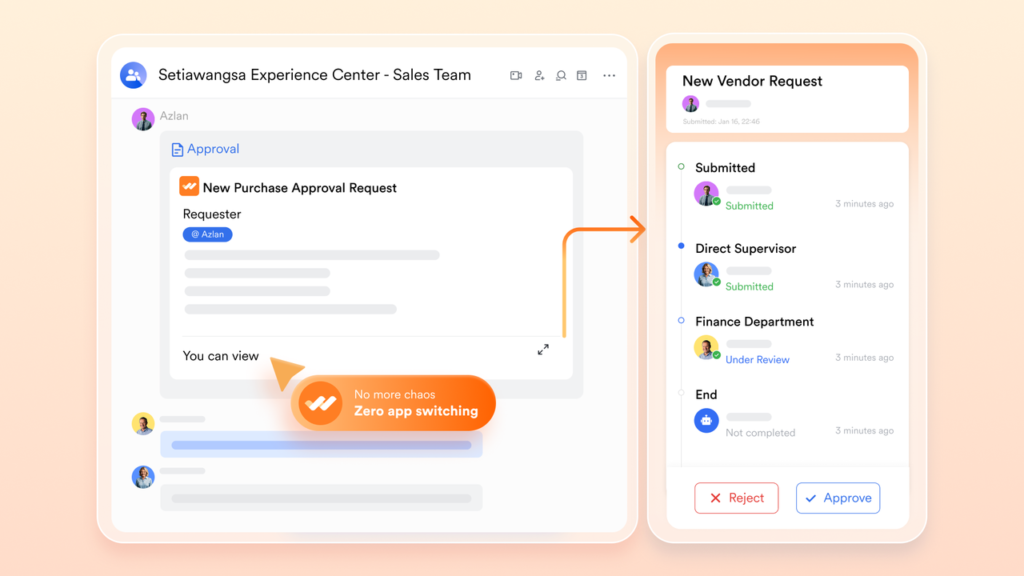
Lark Approval structures the approval request so that it travels with the full context of the work it concerns. The approval submission can include links to the relevant Lark Docs, the Slides deck, and the Base record that shows the full revision history, so the approver arrives at their decision with the complete picture rather than making a judgment in isolation. “Conditional Branches” ensure that creative work requiring sign-off from both the brand team and legal is sent to both simultaneously rather than sequentially, so the total approval time does not compound across two separate review cycles. “Approval Notifications” deliver the outcome immediately to every relevant party, so the team can move to production the moment the green light is given rather than waiting for someone to relay the decision.
One channel for all feedback communication with Lark Messenger
Even when feedback is well-structured within a document, the conversation around that feedback often spills into chat, and the chat conversation that follows a review round frequently contains important clarifications, context, and decisions that never make their way back into the document. A reviewer leaves a comment asking for a shorter headline. The writer responds in Messenger asking for clarification. The reviewer explains what they mean. The writer understands, makes the change, and resolves the comment. The Messenger exchange that contained the actual reasoning behind the revision has now disappeared into message history, unavailable to anyone who later needs to understand why the headline changed.
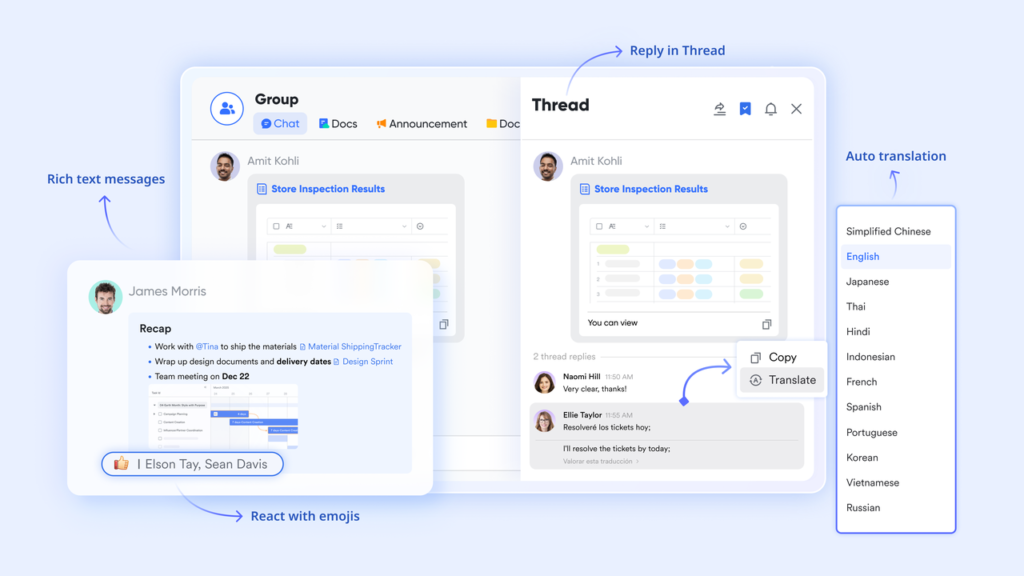
Lark Messenger’s “Chat Tabs & Threads” keep the feedback conversation for each creative project anchored in a structured thread within the project group rather than scattered across direct messages and general channels. “Rich Formatting” allows reviewers to include annotated screenshots and formatted text in their feedback messages, so the communication around a revision carries the same specificity as a comment in the document itself. When a piece of work reaches final approval and is archived, the Messenger thread for that project travels with the Base record as part of its operational history, so the reasoning behind every revision decision is permanently recoverable rather than lost in a chat history that nobody can search effectively.
Bonus: Why creative tools alone do not solve the revision problem
The standard creative team stack attempts to solve the revision problem with specialist tools: Figma for design review, Frame.io for video feedback, Google Docs for copy review, and Slack for the conversation that connects all three. Each tool handles feedback well within its own medium and poorly across the boundaries between mediums. The campaign that involves copy, design, and video creates a feedback environment where each discipline has its own system and no single view of the full project’s review status exists anywhere.
Looking at tools like monday.com and Asana for creative project management alongside Google Workspace pricing as a foundation reveals a system where document feedback, the presentation feedback, the asset tracker, the approval workflow, and team communication all live in separate places. Lark keeps all five in the same environment, so the creative team’s review process has one home rather than five, and the revision loop has nowhere left to run.
Conclusion
The revision loop is not a creative problem. It is a coordination problem that happens to live inside the creative process. When feedback is anchored to the work, approvals travel with context, asset status is always current, and team communication stays structured around the project rather than scattered across channels, the loop closes naturally rather than being driven around again by the friction of a fragmented feedback infrastructure. A connected set of productivity tools that gives feedback a single location and a clear resolution path is how creative teams stop losing half their time to the revision cycle and start spending it on the work itself.