
Introduction
Aerospace project managers are in trouble when it comes to tight CNC machining tolerances, often down to 0.025mm, that require high precision. Overrunning the schedule and increasing cost due to custom work are the things that usually push the budget to breaking point. Local workshops will charge a lot whereas overseas ones will carry the risk of high failure. The usual framework considers cost, quality, and speed three separate things which is most often the reason for poor decision-making. A good Precision CNC Machining methodology would be a combination of smart sourcing, digital workflows, and AS9100D certification. This is a way to keep defects out and also reduce expenses over the long run. So it is probably most effective when all the areas of the supply chain are in agreement.
Why is the custom machining cost for aerospace components so unpredictable?
Estimating costs for aerospace CNC machining metal parts is quite complicated, so you can’t just consider material and labor costs. Several risky factors lead to the fluctuation of custom machining cost. Firstly, problem tool wear results from machining hard materials such as titanium and nickel alloys, thereby also increasing consumable expenses. Secondly, according to research in dimensional metrology, meeting almost perfect CNC machining tolerances requires lengthy and multi-step processes, thereby creating more time and complexity.
Thirdly, in order to adhere to tight tolerances, very precise inspections using high-precision CMMs are carried out, which are quite expensive. Lastly, the typical low-volume, high-mix aerospace production hinders unit price reduction due to economies of scale. Hence, only comparing unit price is quite deceptive because a low bid may contain compromise that would lead to much higher total costs resulting from rework or failure.
How to balance cost control with non-negotiable quality?
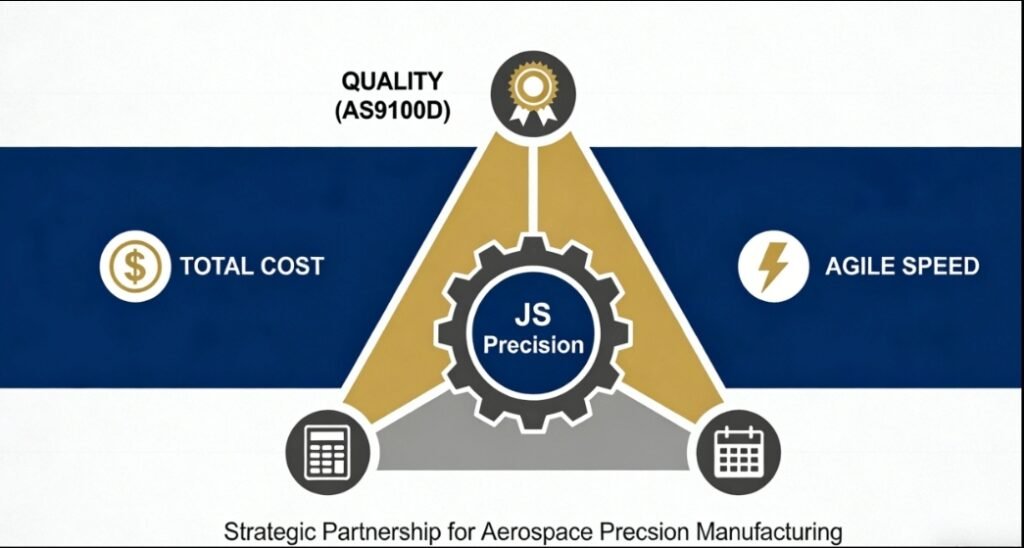
In aerospace, quality is non-negotiable. True cost optimization does not come from price pressure but from systematic process optimization to achieve first-pass yield and avoid expensive late-stage corrections.
Front-End Design Optimization: The Starting Point for Cost Control
Design for Manufacturability (DFM) analysis is also critical in the early stages. Experienced manufacturing engineers can be involved at the quoting stage to make suggestions to simplify the design, optimize tolerancing, or change material to make the part easier to machine without affecting functionality.
Supply Chain Transparency: The Key to Managing Hidden Costs
Transparent quoting and processes are central to managing custom machining cost. This requires suppliers to provide a clear cost breakdown, not a vague total. A deeper dive into the nuances of cost structures is available in this extended resource on custom machining cost. Transparent communication empowers project managers to identify potential risk points and make informed decisions.
The Quality System: The Most Effective Cost Prevention
A mature quality management system is, in itself, the most economical form of cost control. The value of a supplier certified to demanding standards like IATF 16949 (automotive) and AS9100D (aerospace), such as JS Precision, is twofold:
- Prevention Over Inspection:
Such systems mandate building quality into every process step through standardized work and in-process monitoring, drastically reducing the risk of batch non-conformity. - Lowering Total Cost of Ownership (TCO):
A certified supplier’s high first-time yield and near-zero rejection rates cut hidden costs, like project stoppages or line shutdowns – before they build up. The unit price might not be lowest, but delivery is reliable, which keeps total spending under control. Hidden expenses don’t spike because failures are rare. This reduces risk without sacrificing quality.
Beyond ISO 9001: What Quality Assurance System Does the Aerospace Supply Chain Need?
For aerospace CNC machining of metal components, ISO 9001 is just a starting point. Aerospace requires a more stringent standard, a preventive approach, and traceability under AS9100D. It adds essential aerospace requirements with a core focus on “risk management” and “traceability.” It enforces strict controls for “critical items” and mandates exhaustive First Article Inspection (FAI) per AS9102.
Complete traceability—back to the raw material lot and equipment used—is non-negotiable. As underscored by NASA practices, such discipline is fundamental for flight safety, requiring objective verification via advanced metrology. Therefore, choosing an AS9100D-certified supplier for processes like stainless steel CNC machining services means their entire system is built for zero-defect outcomes, providing essential “process insurance.”.
From Quantum Computing Innovations to Aerospace Manufacturing: The Value of an Agile Supply Chain
Much like quantum computing seeks exponential gains in processing speed, modern aerospace manufacturing places a premium on equivalent leaps in supply chain responsiveness. In scenarios common to Aviation Incident Analysis, the need for part replacement or urgent design iteration is directly tied to exorbitant Aircraft on Ground (AOG) costs.
Here, a responsive aluminum CNC service or stainless steel CNC machining services provider is as valuable as a technological breakthrough. The ability to compress the lead time for a prototype or replacement part from weeks to days can swiftly return an aircraft to service. This agility depends on digital collaboration capabilities.
An ideal best online CNC service platform integrates instant quoting, online engineering review, and real-time project tracking. A designer uploads a CAD model and quickly receives manufacturability feedback and a transparent quote; upon confirmation, the order flows directly into a digital scheduling system. This seamless handoff eliminates the back-and-forth lag of traditional communication, creating a “high-speed channel” from digital model to qualified physical part, transforming supply chain agility into a core competitive advantage.
Investing in a Reliable Manufacturing Partner: Long-Term Returns Far Exceed Unit Price
In aerospace precision manufacturing, selecting a Precision CNC Machining supplier should be viewed as a strategic investment, where the long-term returns vastly outweigh unit price comparisons.
Quantifying Hidden Costs to See the Full Picture
True cost extends far beyond the purchase order. The expense of a recall due to part failure, losses from production line downtime, and long-term brand reputation damage can be orders of magnitude greater than the part’s price. A reliable partner mitigates these risks at the root by ensuring quality consistency.
Stable Supply Through Full-Material and Full-Process Capability
A one-stop supplier capable of handling everything from standard aluminum CNC service to complex stainless steel CNC machining services and superalloy machining significantly simplifies supply chain management. You can explore the complete capabilities of such a provider for stainless steel CNC machining services. This versatility ensures stable technical and quality support regardless of evolving design needs, avoiding development bottlenecks or re-sourcing risks due to supplier limitations.
From Transaction to Collaboration: Achieving Total Cost Optimization
A strategic partnership delivers deeper value:
- Collaborative Optimization:
Long-term trust facilitates intensive collaboration in the early stages of the relationship to mutually optimize design for both cost and manufacturability. - Risk Sharing and Process Integration:
A stable partnership permits greater flexibility in capacity planning and inventory management strategies, including models such as Vendor-Managed Inventory (VMI), thereby creating a more robust and efficient overall supply chain with constant optimization of Total Cost of Ownership (TCO).
Conclusion
Processing aerospace parts demands a shift in how we think about buying. It’s not isolated orders anymore, procurement becomes part of the engineering workflow, backed by quality certifications and digital tracking. Changes at the earliest design phase cut costs and prevent risks. Quality control during production keeps standards tight.
Then, responsiveness to customer needs ensures timely delivery. This builds a supply chain that survives shocks and delivers on time. If your next project struggles with tolerances, material choices, or meeting deadlines, upload your CAD files now and get a quote with a full manufacturability review and clear pricing. See how CNC Machining Services can handle your project’s demands without delay.
Author Bio
He is a senior analyst in manufacturing supply chains who has worked in this field for more than ten years. His main areas of expertise include advanced manufacturing technology, lean supply chain management, and the use of quality systems (mostly AS9100, IATF 16949) in aerospace and high-end industrial sectors.
FAQs
Q: What is the fastest turnaround for low-volume, high-complexity aerospace prototypes?
A: For highly critical and time-sensitive projects, a few service providers that have rapid response capabilities may be able to provide a lead time of 3-5 working days. However, the exact deadline depends on material availability, geometric complexity, and final finishing requirements and should be verified through an online quoting system.
Q: How can I ensure precision parts machined overseas will 100% conform to my drawing?
A: The most important thing is to choose a manufacturer that offers comprehensive First Article Inspection Reports (FAIR) along with detailed measurement data. Reliable manufacturers nowadays employ, among other techniques, CMMs for full-dimensional inspection and release material certifications, to guarantee full traceability and conformity from a digital model to the physical part.
Q: Is AS9100D certification valuable for non-aerospace customers?
A: Yes, definitely. AS9100D is recognized as one of the highest benchmarks for quality management systems. Its focus on risk management, traceability, and stringent change control offers outstanding assurance of reliability for any industry that cannot afford quality failures at all, such as medical devices, automotive, and high-end instrumentation.
Q: Could an online CNC machining quote differ significantly from the final price?
A: Professional online quoting systems after an engineering review of the drawings can give very accurate pricing. Big differences in price arise mostly from design changes or if special processing is added. Genuine platforms give a clear cost breakdown after the review, and no hidden fees.
Q: Besides the common aluminum and stainless steel, what aerospace-grade hard-to-machine materials can you process?
A: Aerospace CNC machining metal parts usually include titanium alloys (e.g. Ti-6Al-4V) and nickel-based alloys (e.g. Inconel 718). A reputable service provider should have the experience of manufacturing these materials and should have his own dedicated tooling and process parameter libraries for controlling distortion and ensuring surface integrity.