
Introduction
The highly competitive world of global industrial innovation in 2026 is posing severe challenges to product development teams in terms of long prototyping lead times, quality issues, and unreliable supply chains for precision parts. In most cases, the prototyping phase of the product development process is becoming a bottleneck of cost and time overruns due to the adoption of low-end machining and unreliable vendor networks.
The root cause of the problem is the over-reliance on old manufacturing technology and the absence of systematic and forward-thinking collaboration. This article aims to uncover the potential of the adoption of advanced CNC technology and supply chain solutions to transform the complex prototyping phase of the product development process from a high-risk gamble to a high-speed solution. The subsequent sections of the article intend to unlock the technical blue print for developing a highly efficient prototype production line.
Why is Precision Engineering the Foundation of Modern Industrial Innovation?
Precision Engineering is the game-changer in fields like aerospace, medical devices, and high-end electronics. These industries can’t afford off-by-a-micron mistakes – just one shift means the device fails or gets tossed out. Plus, it seems hard to ignore how much small errors ripple through systems with thousands of parts, Mostly when those parts must work under heat, vibration, or pressure. The whole process isn’t just about measuring size – it’s a full chain from materials to how things are built and tested.
The Micron as the New Benchmark for Performance: Medical gear and space missions don’t have room for error. A fuel injector off by a few microns? That’s not just a glitch, it’s a total breakdown. It’s not just dimension; it’s metrology, material behavior, and tight process control working together to make every piece do exactly what it’s supposed to. This kind of reliability is what actually drives real progress in industrial design.
Enabling Integration in Complex Systems: Products today are complex systems of systems. The flight controller of a drone, the gantry of an MRI machine, or the tray of an electric vehicle consist of the flawless integration of hundreds of accurately made parts. The language of precision, which guarantees this integration, is the domain of precision engineering. The systemic need for precision, therefore, is the linchpin of the vision of smart manufacturing, as encapsulated in the resources published by the National Institute of Standards and Technology (NIST) on smart manufacturing, which highlights the importance of measurement science and standards in enabling smart manufacturing.
From Prototype to Production: The Consistency Imperative: While the ultimate test of precision lies not in the creation of one first-article part that is accurate, but in the ability to create ten thousand such first-article parts, the methodologies, strategies, and controls put in place during the prototyping phase must be able to scale. The precision engineering foundations put in place ensure that the performance achieved in the first article is consistently achieved in the production phase, thus justifying the substantial investment made in R&D and design.
How Does the CNC Turning Process Redefine Component Prototyping Speed?
The contemporary CNC Turning Process is a paradigm shift in speed and flexibility for producing rotationally symmetrical and complex cylindrical components. It has transformed from a sequential and manual process to an integrated and automated process. It integrates several machining processes such as facing, turning, grooving, boring, and threading into a single setup on a multi-axis lathe. In this process, there are no cumulative errors and handling times associated with traditional processes. It is a major step towards achieving unprecedented Project Efficiency and reducing the overall process times from weeks to days.
1. Multi-Axis Capability and Single-Setup Machining
The CNC turning process uses a sophisticated CNC lathe with live tooling (mill capability) and a second spindle (for part pick-up and back-working), enabling a part to be made in one chucking operation. In other words, all the features of the workpiece are machined in a single coordinate system. In this process, there are no repositioning errors associated with traditional processes. There is a significant reduction in non-cut times from a digital model to a physical model ready for testing.
2. Digital Integration and Rapid Iteration
This acceleration is also multiplied by the digital integration of workflows. CAD designs are directly translated into machine code (G-Code) by computer-aided manufacturing software. To gain a deeper understanding of the technical intricacies that make this process possible, there are many online resources that offer detailed analyses of the entire process from a specific perspective, such as this comprehensive guide to precision CNC turning services. This digital integration makes it possible to make instant changes; a design can be made in a matter of hours, not days.
3. The Direct Impact on Development Cycles
The overall combined impact of these changes lead to voxel-scale prototyping that is highly compressed. If earlier it would have taken several machines, operators, and quality control processes for production, now it can be done autonomously. This implies that the R&D departments will be able to run many more tests, discover their errors quicker, and find the best solution in a very short time. It is indeed a significant competitive advantage.
What are the Critical CNC Turning Benefits for Complex Supply Chain Solutions?
While speed is a significant aspect of CNC turning, the natural repeatability, efficiency of materials, and quality consistency of modern CNC turning offer a foundation of benefits that can add strength and efficiency to complex supply chain solutions. In a world where supply chain strength is a top concern, the ability to deliver quality components reliably, locally, and on-demand reduces overall costs of ownership and minimizes supply chain risks.
1. Unmatched Repeatability and Quality Assurance
Unlike other machining methods, CNC machining is not based on skills but on programming. Once a process is validated for a prototype part, the program can be run to make one part or ten thousand parts with little to no change in the process. This provides unmatched repeatability in the process and greatly reduces the need for quality audits and “ramp-up” variations commonly experienced when working with new suppliers or skills.
2. Material Optimization and Reduced Lead Times
State-of-the-art CAM tools also feature sophisticated nesting and optimization techniques that ensure the highest possible material efficiency from the raw bar stock material. Additionally, the elimination of secondary operations and the resulting supplier dependencies are achieved by integrating Design for Assembly principles enabled by multi-axis turning capabilities, allowing for near-net-shape manufacturing of components and thereby minimizing the need for secondary operations.
3. Design Standardization and Manufacturing Feasibility
One of the greatest advantages of using computer-aided design and manufacturing is the enforcement of design discipline that makes manufacturing much easier and more cost-effective. By considering the capabilities and limitations of CNC turning machines while designing components and adhering to standard tooling sizes, accessible geometries, and logical tolerances, it becomes possible to design components that are more accessible and affordable from a much larger number of qualified suppliers. This concept is captured in standards such as ASME Y14.5 on geometric dimensioning and tolerancing, which provides a universal language for design and manufacturing teams to ensure design intent is manufacturable.
How Can Proactive DFM Analysis De-risk High-Precision Manufacturing?
Proactive DFM analysis is the most effective and cost-saving strategy in the product development process to mitigate potential manufacturing issues before they occur. It is a bridge between the intent of the design and the reality of manufacturing to ensure that not only is the concept brilliant but also its manufacturability is equally brilliant. Participating in DFM analysis at the early stages of product development can change the prototype phase from a costly debugging process to a seamless one.
1. Identifying and Resolving Geometrical Pitfalls
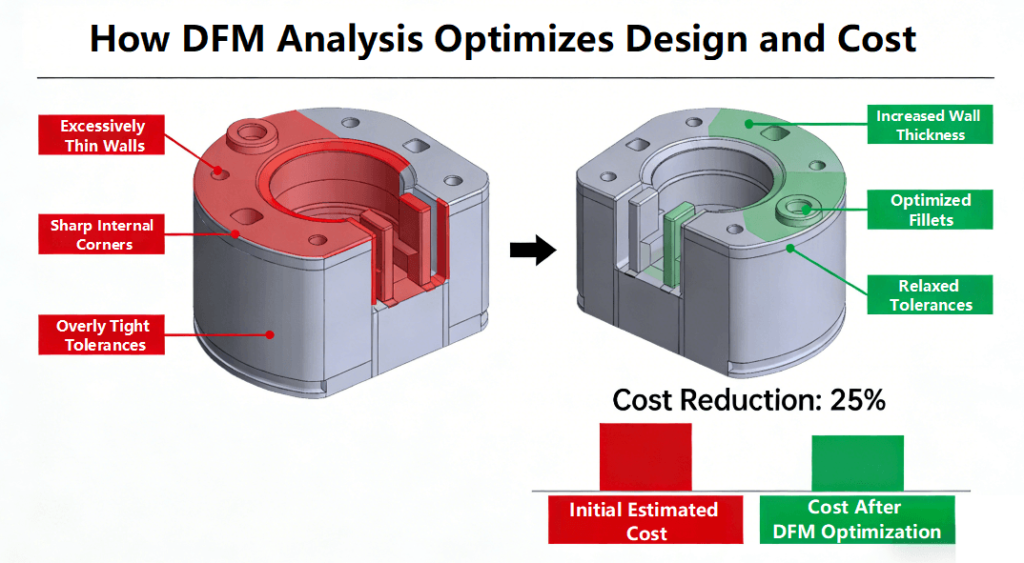
A skilled DFM analysis examines the model for areas of the design that are hard to machine or impossible to machine at all. This includes walls that are too thin and tend to vibrate when machined, internal features that are hard to machine due to poor tool accessibility, overly tight tolerances that drive up costs unnecessarily, and internal corners that are too sharp and require special tooling to machine correctly.
2. Optimizing for Process and Cost
Real DFM does not simply identify problems; it also provides optimal solutions for those problems. An expert might suggest a small change to a corner radius to accommodate a standard tooling solution, a more machinable but equally effective material choice, or a design change that could combine two parts into one. Such optimization, based on a deep understanding of the Advanced Machining processes, has a proven ability to reduce the cost of a part by 15-25% without compromising performance.
3. The Role of Certified Quality Management Systems
The level of rigor in a DFM analysis is significantly enhanced when it is executed within a certified quality management system. Companies that have earned stringent quality certifications such as IATF 16949 for the automotive industry or AS9100D for the aerospace industry are mandated to follow a set of processes for assessing risks, including production feasibility analysis. Such a systemic approach to DFM analysis does not simply rely on opinion; rather, it becomes a rigorously executed discipline aimed at eliminating risks in high-precision manufacturing from the outset.
Why Should Global OEM Partners Prioritize Specialized CNC Turning Services?
When it comes to big global OEMs, opting for a manufacturing partner is a major decision affecting intellectual property security, product quality, and at last, the brand’s image. Hence, specialized CNC turning services are not just machine access; besides, they provide a partnership that is critical for delivering high-quality and safe complex components such a partnership also becomes the basis of project efficiency and Innovation.
1. Access to Integrated Engineering Expertise
A specialized services provider acts as an additional resource or extension of your engineering team. They have experience that spans multiple industries and by reporting problems similar to those encountered in medical aerospace automotive industries, they have addressed and solved these types of issues. Utilizing this expertise is the key to ensuring that you will not be overlooked when it comes to deciding on materials to be used, finishing options, and parts assembly.
2. Assurance through Certified Quality Systems
Getting certifications is one of the ways to ascertain a partner’s dedication to quality and consistency. A partner that has received certification to the ISO 9001 standard is known to have a quality management system in operation. Nevertheless, for automotive or aerospace projects, IATF 16949 or AS9100D certification is essential. Partners comply with these standards by engaging in, amongst other things, advanced quality planning, statistical process control, and complete traceability. Thus, OEMs are confident that every part, whether it is the first prototype or the final production part, will be in line with the highest industry standards.
3. Seamless Scaling from Prototype to Production
One benefit of collaborating with a partner who can do both the prototype and production is the continuity. If a prototype is being developed with a partner who has the capabilities of handling high-volume production, it is a way to ensure the seamless transition. But to companies that want to guarantee the smooth transition of the project from the initial design to the final production phase, it is necessary to collaborate with a partner that can provide CNC turning services.
What Factors Influence CNC Turning Pricing in the 2026 Competitive Market?
Understanding the factors which affect CNC turning pricing is very important especially in the highly competitive market of 2026. Pricing is not just a matter of the time of machining, and there are several factors which need to be considered. Therefore, a strategic approach will lead teams to redesign the products so that the budget is not forced to be stretched.
- The Primary Cost Drivers: Material and Geometry: The cost of the material and the geometry of the material are the primary cost drivers. For example, the machining cost of Inconel or Titanium is much higher compared to the machining cost of Aluminum. The geometry of the material is another major cost driver. For example, the machining cost of the material with deeper holes, thinner walls, finer threads, and closer tolerances is much higher.
- The Impact of Precision and Post-Processing: The impact of tolerance and surface finish on cost can be exponential. The cost of maintaining a tolerance of ±0.025mm can be exponentially higher compared to one of ±0.1mm, especially if this requires the use of slower feeds, more accurate tooling, and the need for in-process inspection. In addition, secondary processes such as grinding, anodizing, or heat treating also have their own associated costs.
- Strategic Levers for Cost Optimization: The best cost optimization strategy is achieved during the design stage through a collaborative approach known as DFM. Design for cost optimization can include reducing complexity, eliminating unnecessary tolerance levels, using the most cost-effective material despite its potential performance, and designing for standard tooling. Such strategies can reduce overall cost by 20% or more. Working with a contract manufacturer and using their free guides on design optimization can provide the best chance of delivering high-performance products within budget, driving the need for smarter Industrial Innovation.
Conclusion
In the manufacturing scenario of 2026, the key to successful projects is no longer merely gaining access to state-of-the-art manufacturing technology but also forging strategic alliances based on precision engineering disciplines, DFM, and globally accepted quality systems. It is only through such an integrative approach to manufacturing solutions — embracing ASME Y14.5, DFM, and collaborating with certified experts — that businesses can hope to drastically shorten their development cycles and turn manufacturing from a potential threat to a definite competitive advantage. Such an integrative approach is the key to turning ambitious designs into successful realities quickly and assuredly.
H2: FAQs
Q: What is the CNC turning process, and how is it optimized for efficiency in the production of complex prototypes?
A: The CNC turning process is a highly optimized process for the production of complex prototypes as it involves the integration of several machining processes like facing, threading, and boring in one setup using the CNC lathe machine.
Q: Why is IATF 16949 and AS9100D certification important when choosing CNC turning services?
A: IATF 16949 means the shop follows strict quality rules for auto parts. AS9100D applies to aerospace, same standards, just different industries. Both require. Advanced Product Quality Planning and statistical Process Control. That means every part has a clear path from start to finish. You know where it came from. And you know it won’t fail in production.
Q: What contributes the most to the price of CNC Turning for high-precision parts?
A: The primary factors that weigh on the price of CNC Turning for high-precision parts are the cost of the materials and how easily they can be machined, the intricacy of the part’s shape, and the degree of difficulty of any additional operations that might be necessary.
Q: How does a professional analysis for DFM benefit the prototyping phase?
A: With a professional analysis for DFM, design problems such as unrealistic tolerance stacking or critical geometry issues can be caught while the design is still in the computer, eliminating costly mistakes such as tool interference or part integrity issues before any material is ever cut, so the first prototype can be both functional and designed for the most efficient and cost-effective means of production.
Q: Can customized CNC turning services be a good fit for low-volume industrial innovation projects?A: Definitely. Technological advancements in CNC turning services made them more flexible and adaptable therefore besides mass production, they can work well also with short runs like prototyping. Thus, R&D teams will be able to get their revolutionary products to market quicker and more efficiently without being bound by the need for high minimum order quantities.